Something Out There: The Unidentified Calls Haunting Appalachian Nights
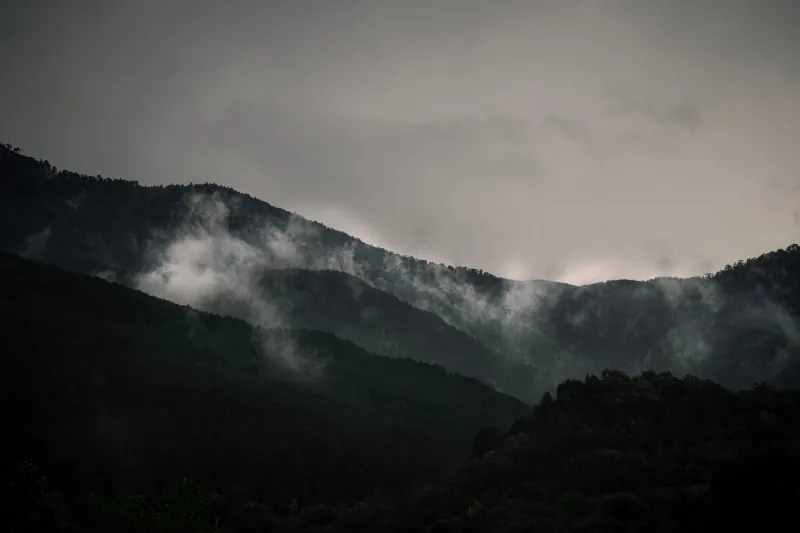
Randy Hensley has been running coon dogs through the ridges of Yancey County, North Carolina, since he was old enough to keep up with his grandfather. He knows the bark of a gray fox, the scream of a bobcat, the hollow yowl a great horned owl throws down from a white oak at two in the morning. He knows all of it the way you know your own kitchen in the dark — by feel, by memory, by instinct honed over decades.
So when he heard something he didn't recognize on a Tuesday night in late October, it stopped him cold.
"It wasn't a cat. It wasn't a bird. It wasn't anything I'd ever put a name to," he said, leaning against the tailgate of his truck at a pull-off just outside Burnsville. "It came from down in the laurel hell, two long notes and then a kind of — I don't know — a gargling drop at the end. My dogs wouldn't go near it."
Hensley isn't the kind of man who spooks easy. And he's not alone.
A Tradition of Strange Testimony
Across the Southern Appalachians — from the ridgelines of southwest Virginia down through the Tennessee highlands and into the deep coves of northern Georgia — people have been describing unfamiliar animal sounds for as long as anyone can remember. Some of these accounts are old enough to have settled into local legend. Others are fresh, reported by trail runners and weekend backpackers who pull out their phones and find no matching audio in any app they try.
The sounds get described in remarkably consistent ways, even by people who've never compared notes. A low, resonant two-note call. A rising shriek that cuts off abruptly. Something that one hiker near Roan Mountain called "like a woman laughing underwater." The details vary, but the sense of wrongness is nearly universal — that feeling that whatever made the sound belongs to a category your brain doesn't have a folder for.
Folklore has always had answers, of course. The mountains are thick with stories of painter cats (the old Appalachian word for mountain lions), mystery dogs, and things older than any of that. Some communities have their own names for what's out there. But the interesting thing isn't the mythology. It's the fact that credible, experienced outdoorspeople keep reporting these sounds decades after the legends were supposed to have been explained away.
What the Biologists Say — And What They Don't
Wildlife biologist Cara Sutton, who spent six years conducting acoustic monitoring surveys across the Nantahala and Cherokee national forests, has heard her share of ambiguous recordings. She's careful with her words.
"There are documented species in these mountains that most people never encounter," she said. "Eastern hellbenders, timber rattlesnakes, fishers — the fisher population is still reestablishing, and their calls are genuinely alarming if you're not expecting them. A lot of what gets reported as 'unknown' turns out to be a known animal in an unusual context."
But she adds a qualifier that's easy to miss if you're not listening for it: "Not all of it, though. I have recordings from two separate sites that I've run past every ornithologist and mammalogist I know, and nobody has a confident answer. That doesn't mean it's something new. It might be degraded audio, a weird echo effect in a hollow, an animal doing something atypical. But I'm not going to tell you it's definitely solved, because it isn't."
That kind of careful uncertainty is more common among field researchers than you might expect. The Southern Appalachians are, by any measure, one of the most biodiverse temperate ecosystems on the planet. New species of salamanders, beetles, and fungi are described here with some regularity. The idea that the acoustic landscape is fully mapped is, at minimum, an assumption worth questioning.
The Tracker's View
Jim Cooke has spent thirty years leading hunting and tracking courses out of his property near Flag Pond, Tennessee. He keeps a notebook — spiral-bound, coffee-stained — of unusual sign and sound reports from students and clients going back to the early 1990s. It's not a scientific document. But it's a record, and records matter.
"The one that comes up most," he said, flipping through pages, "is something people describe as a double knock followed by a call. Like something hitting a tree, then vocalizing. I've had eight, maybe ten separate people describe that over the years, all from different drainages, none of them knowing about the others."
The double knock detail is interesting because it's also associated, in contested cryptozoological circles, with reported ivory-billed woodpecker activity — a bird officially declared extinct in 2021 after decades of disputed sightings and recordings. Cooke doesn't make that connection himself, and he's skeptical of the wilder theories. But he doesn't dismiss the pattern either.
"I'm not here to tell people what they heard," he said. "I'm here to tell people to pay attention. These mountains have been surprising people for a long time."
Acoustics, Echoes, and the Limits of the Ear
Part of what makes this conversation complicated is the terrain itself. The hollows, coves, and ridge systems of the Southern Appalachians are acoustic environments unlike almost anywhere else in the eastern United States. Sound behaves strangely here. A call originating half a mile away can arrive distorted, layered, or stripped of its identifying characteristics by the time it reaches a human ear. Researchers who study bioacoustics in mountainous terrain know this well.
"You can have a barred owl call that bounces off two ridge faces and arrives sounding like something completely alien," said one acoustic ecologist who asked not to be named, noting they weren't speaking in any official capacity. "I've confused myself with my own recordings. The mountains are not a clean listening environment."
That caveat doesn't close the door entirely, though. It explains some reports. It doesn't explain all of them, particularly those made at close range by experienced observers in calm conditions.
Why It Matters Beyond the Mystery
There's a temptation to frame all of this as a campfire story — entertaining, spooky, ultimately harmless. But there's a more serious undercurrent worth sitting with. The Southern Appalachians are under pressure. Habitat fragmentation, development, climate shifts creeping up the elevation gradient — these are real forces changing what lives here and how it behaves. Animals move. Ranges shift. Species that haven't been documented in a given area for decades occasionally turn up again.
If longtime residents and experienced trackers are consistently encountering something they can't identify, that's data. Imperfect, anecdotal, hard to publish — but data. The history of wildlife biology is full of creatures that were known to local communities long before they were known to science.
Randy Hensley put it plainly, back at that pull-off outside Burnsville, as the last light went out of the sky over the ridge.
"I'm not saying it's a monster. I'm not saying it's something nobody's ever seen. I'm saying I've been in these woods my whole life, and I heard something I couldn't name. And I don't think I'm the only one."
He's right about that last part, at least. Out in the dark, in the laurel and the hemlock and the old cove hardwoods, something is calling. Whether science catches up to it or not, the mountains aren't waiting around for an explanation.