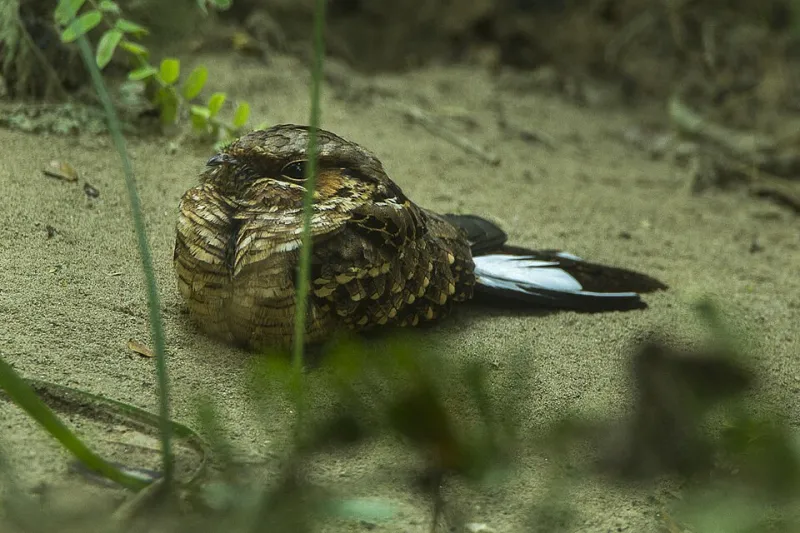
After Dark in the Appalachians: The Creatures You Never See Are Running the Show
Most folks who love these mountains experience them in daylight — morning mist on a ridgeline, a hawk circling a thermal above a bald, the flash of a scarlet tanager in a creek-side thicket. But ask any wildlife biologist who's spent serious time in the Southern Appalachians, and they'll tell you the same thing: you're only catching half the story.
The other half starts right around dusk.
A World That Wakes When You Sleep
Dr. Lena Forsythe has been studying mammal behavior in the Southern Appalachians for going on twelve years. She works out of a small research station tucked into the Nantahala National Forest in western North Carolina, and her office is papered with thermal images and spectrogram printouts that most people would mistake for abstract art. To her, they're field notes.
"We've had this tendency to think we understand these forests because we hike them, camp in them, photograph them," she said, leaning back in her chair. "But we're diurnal creatures. We naturally assume the world runs on our schedule. It doesn't."
What Forsythe and a growing network of citizen scientists are doing is methodically dismantling that assumption. Using a combination of motion-triggered trail cameras, acoustic monitoring arrays, and GPS collar data, they're building what amounts to a nightly census of Appalachian wildlife — a portrait of an ecosystem that has been quietly thriving in the dark for centuries.
The results have been, in a word, revelatory.
Bears on the Night Shift
Take the black bear. Most people think of them as crepuscular at best — active around dawn and dusk, sleeping through the heat of the day. That's still largely true in deep wilderness. But in areas where bears have had sustained contact with human settlements — trail heads, campgrounds, rural communities along the forest edge — something interesting is happening.
The bears are going nocturnal.
Camera trap data from multiple sites across the Blue Ridge and Great Smoky Mountains shows a clear behavioral shift. Bears in high-contact zones are increasingly active between 10 p.m. and 4 a.m., avoiding the hours when people are most likely to be present. They're not becoming less bold, exactly. They're becoming smarter about timing.
"It's adaptation in real time," Forsythe said. "They've figured out that the same territory that's risky at noon is perfectly navigable at midnight. That's a significant cognitive adjustment."
For conservationists, this raises complicated questions. On one hand, the shift suggests bears are finding ways to coexist with expanding human footprints rather than retreating from them entirely. On the other, it means interactions that do happen — a hiker catching a bear in a campsite after dark — tend to be more startling for both parties.
Owls and the Acoustic Map
If bears represent the mammal side of the nocturnal story, owls are its soundtrack.
The Southern Appalachians host a remarkable diversity of owl species — barred owls, great horned owls, eastern screech-owls, and the elusive northern saw-whet owl among them. For years, monitoring these birds meant long nights in the field with a flashlight and a lot of patience. Now, passive acoustic recorders — weatherproof devices that capture audio continuously and store it for later analysis — are doing that work around the clock.
Volunteer networks, many of them coordinated through platforms like eBird and iNaturalist, are deploying these devices across the region and uploading thousands of hours of nighttime audio. Software trained on bird vocalizations then flags owl calls for human review — a process that's generating range data at a scale that would have been impossible a decade ago.
What the maps are showing is that barred owls in particular have expanded their territory significantly over the past twenty years, likely benefiting from forest fragmentation that creates the woodland-edge habitat they prefer. Meanwhile, saw-whet owls — small, secretive, and deeply dependent on mature forest — are proving harder to find in areas where old-growth stands have been logged or degraded.
"The owls are basically a report card," said Marcus Webb, a retired schoolteacher from Sylva, North Carolina, who runs a network of acoustic monitors across Jackson and Macon counties as part of a regional volunteer effort. "A healthy forest has a full chorus. When species start dropping out of that chorus, something's wrong."
The Salamander Surprise
Not everything nocturnal in these mountains has feathers or fur. One of the more unexpected findings from recent nighttime surveys involves salamanders — specifically, the extraordinary density of them moving through the forest on wet spring and fall nights.
The Southern Appalachians are, by any measure, the salamander capital of the world. Nowhere else on Earth hosts as many species in as concentrated an area. But because salamanders are small, secretive, and most active after rain in the dark, they've historically been undercounted.
Recent efforts to do systematic nighttime road surveys — walking or slow-driving rural roads after rainfall to count crossing salamanders — have produced numbers that have genuinely surprised researchers. Some sites in the Smokies and surrounding national forests are showing densities that suggest the salamander biomass in these mountains rivals or exceeds that of all the birds and mammals combined.
"They're the hidden engine of the forest," Forsythe said. "Nutrient cycling, prey base for everything from raccoons to herons — salamanders are doing enormous ecological work that we're only just beginning to quantify."
What the Night Tells Us
All of this nocturnal monitoring is adding up to something larger than a species list. It's producing a baseline — a before picture — against which future change can be measured.
Climate shifts are already affecting the timing of nocturnal activity in measurable ways. Warmer fall temperatures are compressing the window during which black bears enter torpor. Salamander migration events tied to the first warm rains of spring are shifting earlier. Owl breeding seasons are showing subtle but detectable drift.
These changes aren't catastrophic yet. But they're signals, and the networks of cameras, microphones, and dedicated volunteers spread across these mountains are making sure those signals get heard.
For Webb, who started his monitoring project after retiring, it's become something close to a calling.
"I grew up in these mountains," he said, pulling on his jacket as we headed out toward one of his recorder stations at the edge of a hemlock stand. "I thought I knew them. Turns out I only knew the daytime version." He smiled and clicked on his headlamp. "The nighttime version is something else entirely."