She Knew Before the Clouds Did: The Mountain Women Who Carry the Weather Inside Them
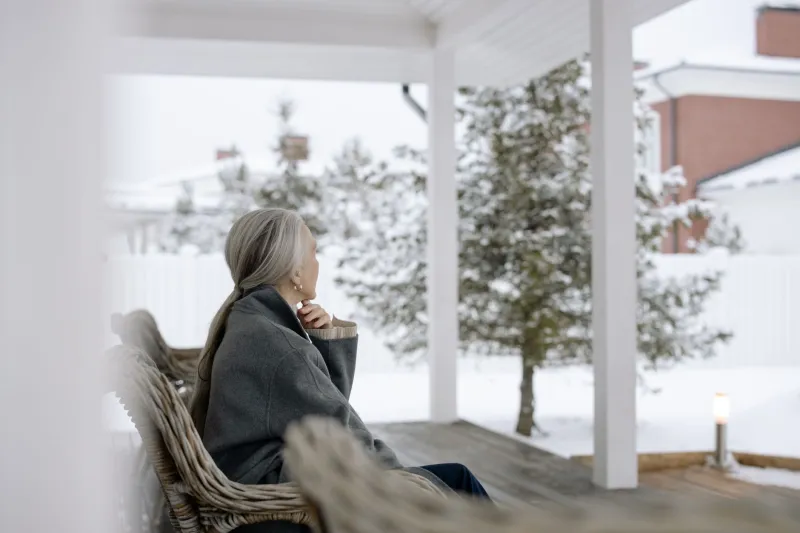
Ruby Hensley can tell you it's going to rain before a single cloud shows up on the ridge. She doesn't check her phone. She watches her chickens. When they start dustbathing in the late afternoon and won't quit, she heads inside and pulls her laundry off the line. She's been right more times than she can count — and wrong so rarely she's stopped keeping track.
"The animals don't lie," she says, sitting on her porch in Letcher County, Kentucky, the hills pressing in close on all sides. "People do. Machines do. Animals just know."
Ruby is 74. She learned what she knows from her mother, who learned it from hers, in an unbroken chain of observation stretching back through generations of mountain women who had no choice but to read the world around them with precision. Your survival depended on it. A sudden storm could flood a hollow, flatten a crop, or trap a family on the wrong side of a creek for days. Getting the weather wrong wasn't an inconvenience. It was a catastrophe.
More Than an Old Wives' Tale
It's easy to write this kind of knowledge off as folklore — charming, maybe, but not serious. That would be a mistake.
The observations these women pass down are rooted in real atmospheric science, even if the vocabulary is different. When an elder says the mountains look "too close" on a clear morning, she's describing a phenomenon meteorologists call abnormal refraction — light bending through a moisture-heavy atmosphere in a way that makes distant ridgelines appear sharper and nearer than usual. It's a reliable indicator of incoming low pressure and rain within 24 to 48 hours.
When she says her joints ache, she's not imagining it. Barometric pressure drops before a storm, and connective tissue in arthritic joints responds to that change in measurable ways. The body becomes its own barometer.
When she notices that the smoke from a neighbor's chimney is hanging low and drifting sideways instead of rising straight, she's reading the same pressure differential that a weather station would clock. She's just reading it with her eyes instead of an instrument.
This is embodied science. It doesn't come with a certificate, but it comes with something better — decades of field testing in the specific hollows, ridges, and creek bottoms where these women live.
What the Official Forecast Misses
Ask anyone who's spent real time in the mountains and they'll tell you: the weather here does what it wants. A forecast built on regional data can be meaningfully wrong within the span of a single ridge. A storm that flattens one hollow might leave the next one completely dry. The terrain creates microclimates so localized that no satellite can map them with the precision that comes from living inside them for fifty years.
Patricia Combs, who grew up in a remote section of Harlan County and now teaches at a community college in Whitesburg, has spent years documenting the gap between official forecasts and what actually happens in isolated mountain communities.
"The forecasters are doing their best with general models," she says carefully. "But general isn't good enough when you're trying to decide whether to get your hay in or whether a creek is going to rise. The women I grew up around — they were specific. They were tuned to this particular place. That's a different kind of accuracy."
She recalls her grandmother stepping outside at dusk, scanning the sky for what she called "the green tint" — a faint yellowish-green cast to the evening light that the old women associated with severe weather. Modern meteorologists recognize the same phenomenon, caused by the way storm clouds filter sunlight before a major system. Her grandmother had no meteorology degree. She had forty years of watching the same sky from the same porch.
Reading the Signs
The catalog of knowledge these women hold is wide and specific. Some of it is animal behavior: cows lying down before rain, spiders building unusually thick webs before a cold snap, katydids going quiet when the pressure drops. Some of it is plant-based: the way certain flowers close their petals before a storm, the way mosses seem to brighten just before rain. Some of it is sky-reading: the shape and color of clouds, the ring around the moon, the direction the wind shifts at sunset.
And some of it is harder to categorize — a general unease, a heaviness in the air, a sense that something is building. Women who've spent decades outdoors describe developing a kind of full-body attunement to atmospheric change that they struggle to put into words.
"You just feel it," says Alma Frazier, 81, of Mingo County, West Virginia. "Like the air gets a different weight to it. I can't explain it better than that. But I've never been wrong about a bad storm."
Passing It Forward
The question isn't whether this knowledge works. The question is whether it survives.
In some pockets of the mountains, it is. Younger women are seeking out their grandmothers and great-aunts with real urgency — not as a nostalgic exercise, but because they've noticed the gaps in what technology tells them and what actually happens outside their windows.
Several folk schools and cultural heritage organizations across the region have begun hosting informal workshops where elder women share weather-reading traditions alongside other land-based skills. The response has surprised the organizers. People are hungry for this.
Twenty-six-year-old Cassie Mullins, who returned to her family's land in Pike County after a few years in Lexington, has been spending time with her great-aunt specifically to learn weather signs.
"I got caught in a flash flood my second summer back," she says. "My phone said clear skies. My great-aunt, if I'd asked her, would've told me to stay home. I didn't know enough to ask. I'm learning now."
She keeps a small notebook. She's been writing down everything.
The Sky Hasn't Changed
There's something quietly radical about the idea that the most reliable weather forecast in certain parts of Appalachia might still live in the memory of a woman in her eighties who never owned a barometer. That the mountains themselves — the way light falls on them, the way smoke moves through them, the way animals behave inside them — are still telling the same story they always have.
The technology is newer. The terrain is not. And the women who learned to read that terrain didn't do it for any grand reason. They did it because the mountains demanded it, and they answered.
Ruby Hensley watches her chickens settle down for the evening. The sky to the west has taken on that particular heavy look she's been seeing all her life.
"Rain by morning," she says, not checking anything. "Maybe sooner."
By midnight, it's pouring.