Grass Won't Win Here: The Mountain Families Still Tending Their Dead by Hand
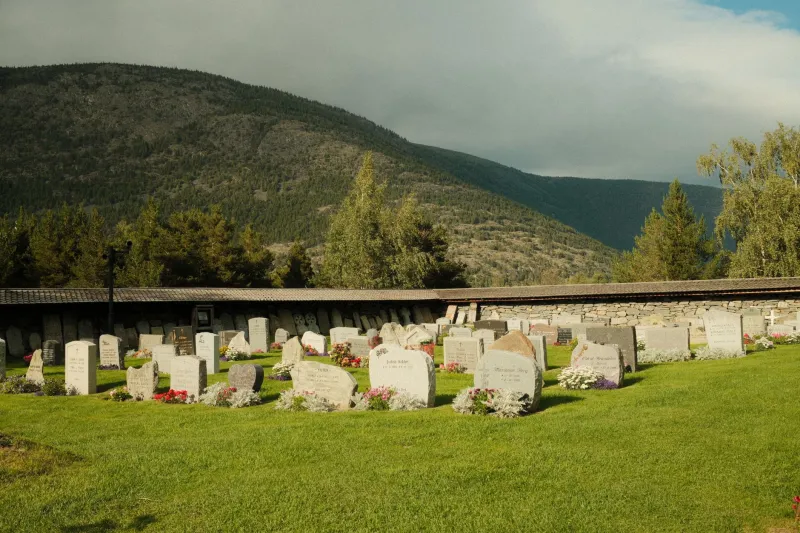
You won't find it on any county map. There's no historical marker nailed to a post nearby, no gravel parking area, no sign pointing you up the ridge. What you will find, if you know whose hollow to turn into and whose gate to open, is a small rectangle of cleared ground tucked between old oaks where the soil rises and falls in soft, deliberate mounds. Plastic flowers, some faded nearly white by seasons of sun. A hand-poured concrete border around a stone that lists slightly to the left. And somewhere nearby, a person with a weed trimmer or a pair of hand clippers, working quietly like they've done it a hundred times — because they have.
Family cemeteries are scattered across the Southern Appalachians the way seeds scatter from a dry milkweed pod — without particular plan, wherever the wind and the land allowed. Some hold a dozen graves. Some hold two. Many of them are the only monuments that remain to families who built cabins, cleared fields, raised children, and grew old in places that the modern world has largely forgotten to notice.
And in most cases, the only reason those cemeteries still exist in any recognizable form is because somebody's cousin owns a push mower.
Nobody's Coming to Help
In many rural Appalachian counties, the law technically protects family burial grounds on private land, but protection on paper doesn't translate to maintenance on the ground. County governments rarely have the budget or the mandate to care for privately held cemeteries, and state historical programs, when they exist at all, tend to prioritize sites with broader public visibility.
That leaves the work to whoever shows up.
For the Hensley family of Harlan County, Kentucky, showing up means a Saturday in late April and another in early October. Three generations pile into a truck — grandmother in the cab, teenagers in the bed — and make their way up a rutted lane to a small cemetery that holds eleven graves, the oldest marked 1887. They bring rakes, a gas-powered trimmer, hand tools, and usually a covered dish or two because someone always ends up hungry.
"We call it Decoration Day, same as people always did," says Wanda Hensley, 71, who learned the tradition from her own grandmother. "You go up there, you clean it off, you put out fresh flowers if you've got them, and you sit a while. It's not a sad thing. It's just what you do."
The practice Wanda describes — known by various names across the region, Decoration Day being the most common — is older than Memorial Day as a federal holiday. In Appalachian communities, it predates the Civil War and likely has roots in both Scots-Irish Presbyterian tradition and older folk practices around honoring the dead. The specifics vary by family and county, but the core impulse doesn't: you tend to your people.
What the Work Actually Looks Like
It's easy to romanticize graveyard tending from a distance. Up close, it's physical, unglamorous labor. Briars grow fast in mountain hollows. Tree roots push up old stones. Groundhogs dig near the edges. Drainage problems turn low spots into mud every spring. And in cemeteries where the oldest graves are unmarked or marked only by fieldstone, there's the constant, careful work of not disturbing what you can't see.
Robert Deel, 58, maintains a family cemetery in Lee County, Virginia, that he estimates holds close to thirty graves, though only about half are marked. He's been doing it since his father's health declined in the early 2000s, and he took over without anyone formally asking him to.
"I just knew it needed doing," he says. "Dad couldn't get up there anymore, and nobody else was going to."
Deelcuts the grass by hand along the grave borders because a riding mower would damage the stones. He's repaired two markers himself using materials he researched online, and he keeps a hand-drawn diagram of the cemetery so he can show family members where everyone is buried. He's also started photographing the graves each year and uploading them to a genealogy site, which has led to contact from distant relatives he'd never met.
"Cousin from Georgia called me out of nowhere," he says, laughing. "She'd been looking for her great-great-grandmother for years. Found her through my pictures."
The Weight of Knowing
There's a particular kind of knowledge that graveyard tenders carry — an intimate geography of family history that exists nowhere in writing. They know whose grave is whose even when the stone is blank, because the story was told to them by someone who was told by someone else. They know that the two small markers in the corner are children who died in the same winter. They know that the man buried under the cedar tree built the house that still stands at the bottom of the hill.
This oral transmission is fragile. When a primary caretaker ages out or passes away, the knowledge they held can go with them unless it's been deliberately passed on.
Carlene Sizemore, a schoolteacher in Breathitt County, Kentucky, started writing things down after her aunt — the family's unofficial historian — died without leaving notes.
"She knew everything," Carlene says. "Every name, every date, every story about who did what. And when she was gone, we realized we only had pieces of it. I swore I wasn't going to let that happen again."
Carlene now keeps a notebook that she updates every Decoration Day. It includes grave locations, family connections, and the stories she's collected from older relatives over the years. She's also started recording audio on her phone during family gatherings, capturing conversations she knows won't happen forever.
"It's not fancy," she says. "But it's something."
Why They Keep Doing It
Ask the people who tend these cemeteries why they do it, and the answers are rarely sentimental in the way you might expect. They're practical. Matter-of-fact. There's a job, and it falls to you, and so you do it.
But underneath the practicality is something harder to name. A sense of obligation that runs deeper than duty. A feeling that the people under the ground are still, in some way, present — and that neglect would be a kind of abandonment.
"They lived hard lives," Wanda Hensley says, looking out over the small Harlan County cemetery her family tends each spring. "They didn't have much. But they're ours. You don't just let the briars take them."
That phrase — you don't just let the briars take them — might be the closest thing to a philosophy that this tradition has ever produced. It doesn't need a mission statement. It doesn't need a nonprofit or a grant. It needs someone willing to load a truck and drive up a hollow once or twice a year and put in the work.
All across the Southern Appalachians, people are still doing exactly that. Quietly, without recognition, because it's theirs to do and always has been.
The grass won't win. Not this year.