Dead Wood Burning: The Strange, Quiet Glow Hiding in Your Appalachian Backyard
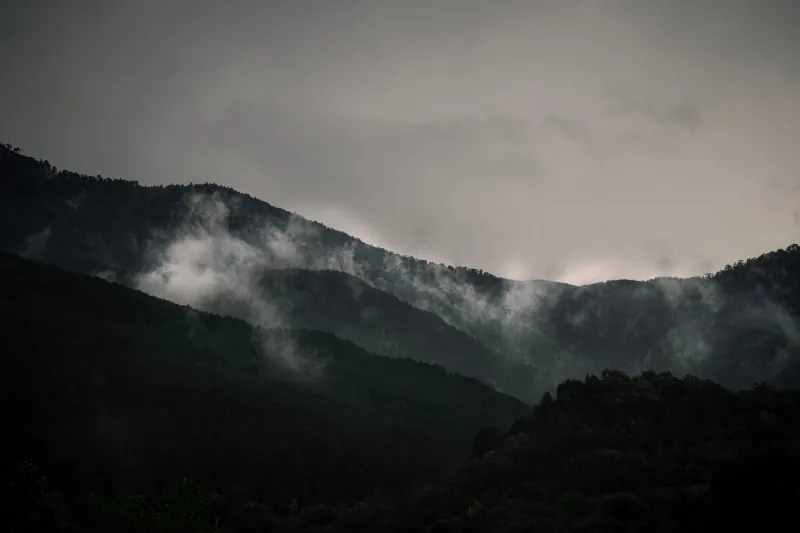
There's a particular kind of dark you only find deep in an Appalachian hollow. Not the dark of a city with the lights off, or the dark of a highway stretch between exits. This is a dark that has weight to it, texture, almost a sound. And on the right night, in the right patch of old-growth timber, that dark gives something back.
A faint, cold, green-blue light seeps from a rotting log. No flashlight. No phone screen. No firefly. Just wood — dead wood — quietly burning with a light that produces no heat and follows no rule you were taught in school.
People around here used to have a name for it: foxfire.
Some still do.
What Foxfire Actually Is (And Isn't)
Let's get the science out of the way, not because it's boring — it isn't — but because understanding what's happening makes the whole thing stranger and more beautiful, not less.
Foxfire is bioluminescence produced by certain species of fungi, most commonly members of the genus Panellus and Omphalotus, along with a handful of others. These fungi colonize decaying hardwood — fallen oaks, old stumps, buried root systems — and as part of their metabolic process, they emit a continuous, low-level glow through a chemical reaction involving luciferin and oxygen. The same basic chemistry that lights up a firefly's tail, stretched into something slow and permanent.
The light itself is genuinely cold. No warmth. No flicker. Just a steady, faint luminescence that sits somewhere between green and blue depending on the species and the wood it's working through. On a moonless night, close to the ground, it can be bright enough to make out shapes.
Scientists are still puzzling over why these fungi glow at all. The leading theory is that the light attracts insects, which then spread spores. But the evidence is thin, and the honest answer is that nobody is entirely sure. The forest keeps its own counsel.
The Old Names, the Old Stories
Foxfire wasn't always a curiosity. For generations across Southern Appalachia, it was a landmark, a tool, and a source of genuine unease.
Cherokee oral traditions reference luminous wood as something between natural phenomenon and spiritual signal — light that appears where it shouldn't, in places where something old has ended. Early European settlers, many of them Scots-Irish with their own deep folklore around cold light and the supernatural, folded foxfire into a patchwork of ghost stories and omens. Will-o'-the-wisp. Corpse candles. The devil's lantern.
More practically, miners in the region's coal and iron operations reportedly used foxfire-covered wood as a low-stakes light source when open flames were too dangerous near gas pockets. Whether that's history or legend depends on who's telling it, but the accounts are persistent enough to take seriously.
Old-timers in Cherokee and Swain counties in North Carolina, and in parts of Sevier County, Tennessee, will sometimes mention seeing it as children — usually in the same breath as something their grandfather pointed out on a night walk, the kind of knowledge passed sideways through generations. "Daddy called it fox light," one retired logger in Bryson City recalled during a conversation at a hardware store a few years back. "Said it meant the wood was working. Said you ought to leave it alone."
That instinct — to leave it alone, to let it do what it does — turns out to be pretty sound advice.
Why It's Getting Harder to Find
Here's where the wonder shades into something more complicated.
Foxfire isn't endangered, exactly. The fungi that produce it aren't on any watch list. But the conditions that allow it to thrive — old, undisturbed hardwood forest, deep duff layers, the slow decomposition of large fallen timber over years and decades — those conditions are increasingly rare.
Managed timber operations remove deadwood. Development fragments the forest floor. Invasive species like the hemlock woolly adelgid alter the composition of what falls and how fast it rots. Climate shifts are nudging moisture patterns in ways that affect fungal communities across the board. Foxfire doesn't need much, but it does need time and stability, and those are the two things modern land use is least willing to offer.
Naturalists who spend serious time in the backcountry of the Great Smoky Mountains, the Nantahala, and the Cherokee National Forest will tell you foxfire sightings have become genuinely uncommon. Not impossible — people still stumble across it, usually by accident, usually while their eyes have adjusted to real dark — but the kind of regular, reliable occurrence that older generations described has quieted down.
That quieting is worth paying attention to. Bioluminescent fungi are what ecologists sometimes call indicator species — their presence or absence reflects the broader health of the system they're part of. When the foxfire dims, it's a signal worth reading.
Finding It, If You're Going to Look
If you want to see foxfire — and you should, at least once — the conditions matter more than the location.
Late summer through early fall is your best window, when warm, wet weather has soaked into the forest floor and fungal activity peaks. You need genuine dark, which means getting well off the trail, well away from any light source, and giving your eyes a solid twenty minutes to fully adjust. The glow is subtle. It won't announce itself.
Look for large, decaying hardwood logs — oak, beech, and maple are good candidates. Get low. Get patient. Don't use your phone.
Hikers and backcountry campers in the Smokies and along the Appalachian Trail through North Carolina and Tennessee report the best luck in old-growth pockets and areas with minimal foot traffic. The fungi aren't shy, exactly, but they tend to show up where the forest has been left to do its own thing for a good long while.
And if you find it, the advice still holds: leave it alone. Don't collect it, don't disturb the log, don't try to harvest a glowing piece to take home. The light fades almost immediately once the wood is moved. Foxfire belongs to the hollow it's in. That's the only place it makes sense.
The Light That Outlasted the Stories
There's something a little melancholy about the fact that foxfire has mostly slipped out of the regional conversation. A phenomenon this genuinely strange — wood that glows in the dark for no obvious reason, in a forest that most people drive past at highway speed — should be impossible to ignore. And yet here we are.
Part of it is that we spend less time in genuine dark than we used to. Part of it is that the kind of slow, attentive woods-walking that foxfire rewards has become less common. And part of it, maybe, is that we've gotten comfortable with the idea that nature's surprises are somewhere else — in a documentary, in a national park, in a place you have to travel to reach.
But foxfire is here. It's in the hollows off roads you've driven a hundred times, in the forest behind the church, in the old-growth patches that somehow survived the last century of cutting and clearing. It's been glowing in the dark since long before anyone had a name for it.
The mountains have always had more going on after dark than most of us realize. This is just one more reminder to look closer — and to let your eyes adjust before you decide there's nothing there.