Coming Home Crooked: The Mountain Kids Who Left, Found the City Wanting, and Came Back to Build Something Real
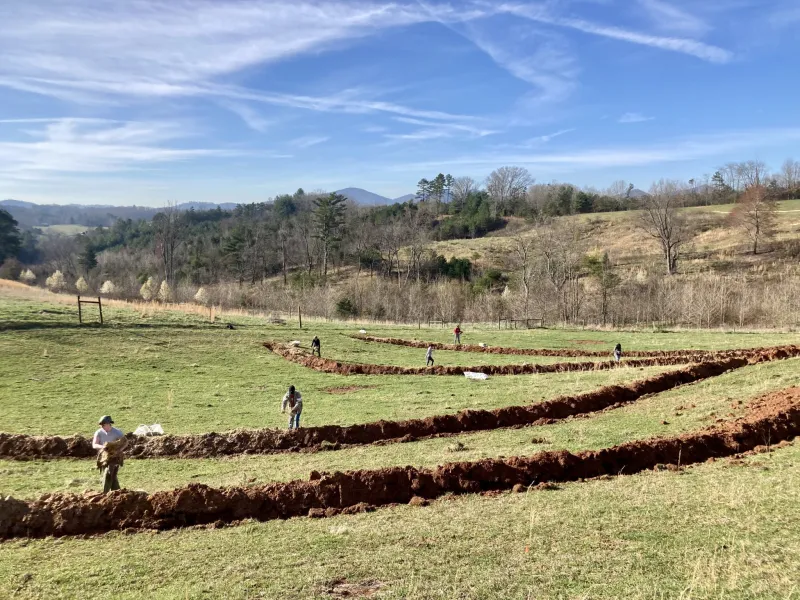
Photo: young farmer Appalachian mountain farm homestead regenerative agriculture, via appalachian.org
Maddie Hensley grew up in a town of about 800 people in Letcher County, Kentucky. She was the first in her family to finish a four-year degree, which she did at the University of Kentucky, followed by a master's program in sustainable agriculture at a school in Vermont. By all conventional measures, she was on her way out — the kind of trajectory that gets celebrated in small-town graduation speeches and then quietly mourned at every class reunion.
She moved to Asheville for a few years. Then to Atlanta. Then, in the spring of 2021, she drove a rented truck back up into the mountains with her partner, a dog, and a plan that her city friends described as either inspiring or baffling depending on their mood.
"People kept asking me what I was going back to," she says, standing in a greenhouse that didn't exist eighteen months ago. "Like the question was obvious. But I kept thinking — what am I going toward? And that answer was a lot clearer."
The Quiet Return
Maddie isn't alone, and that's what makes this story worth telling. Across Southern Appalachia — in the coalfield counties of eastern Kentucky, the small river towns of western North Carolina, the forgotten valleys of southwest Virginia — something is shifting. Quietly, without a lot of fanfare or think-piece attention, young people with roots in these mountains are coming back. And they're bringing skills, ideas, and a particular kind of stubborn love for place that's hard to manufacture from scratch.
This isn't the gentrification story you might be expecting. It's messier than that, and more interesting.
Some of these returnees are native Appalachians who left for education or opportunity and found, after a few years in a city, that they'd been carrying their home in their chest the whole time. Others are what locals sometimes call "come-heres" — outsiders drawn by cheap land, a slower pace, and a landscape that gets into you in ways that are difficult to explain to someone who's never watched fog settle into a mountain cove at dawn.
What they share is a rejection of the idea that Appalachia is a place you survive by leaving.
What They're Building
The projects are as varied as the people behind them.
In Harlan County, Kentucky, a former software developer who grew up there has converted his family's old homeplace into a working herb farm and small-batch apothecary, drawing on traditional plant knowledge that his grandmother practiced and that he spent years learning to formalize. He sells at regional markets and online, and he's started hosting workshops that bring in participants from across the region.
"I spent six years writing code in Denver," he says. "I was good at it. I was also miserable in a way I couldn't explain to anyone around me. Coming back felt like putting weight back on after you've been sick."
In Mitchell County, North Carolina, a collective of young women — some local, some transplants — has opened a craft cooperative that sells hand-spun and naturally dyed textiles, anchored in traditional techniques but marketed with a sophistication that gets them into boutiques in Asheville and beyond. They've hired locally, trained apprentices, and quietly become one of the more stable small employers in a county that's watched jobs disappear for thirty years.
In Wise County, Virginia, a couple who met in a graduate urban planning program is working with the county extension office to develop a community land trust model that would allow young families to access farmland without competing against outside investors. It's slow, bureaucratic work, and they'll be the first to tell you it's not glamorous. But they show up every week.
The Tension Is Real
It would be dishonest to write this piece without acknowledging that not everyone in these communities is thrilled about the homecoming.
Long-term residents — people who never left, who weathered decades of economic decline without the option of a graduate degree or a city salary to fall back on — sometimes look at the returnees with a complicated mixture of welcome and wariness. There's a real concern about rising land prices, about outsiders reimagining a culture they only know from the outside, about the difference between celebrating Appalachian heritage and actually living it through the hard parts.
"There's a version of this that's great," says one longtime community organizer in Breathitt County, Kentucky, who asked not to be named. "And there's a version that's just gentrification with better branding. The difference is whether the people coming in are listening or just performing."
It's a fair challenge. And the returnees who are doing this well seem to know it. They show up to county meetings. They hire local before they hire outside. They ask questions before they offer answers. They understand — or are learning — that trust in these communities is built slowly and lost fast, and that the worst thing you can do is arrive with a lot of enthusiasm and not enough humility.
Maddie Hensley talks about this directly. "I had to come back and be a student for a while," she says. "Not a student of agriculture — I knew that part. A student of this place, of the people who kept it going while I was gone. That took time. It should take time."
What the Mountains Are Getting Back
For all the complexity, something real is happening here. Rural broadband expansion — still incomplete but improving — has made remote work viable in places where it wasn't five years ago. The pandemic reshuffled a lot of people's calculations about what city living was actually worth. And a generation of young Appalachians who grew up being told implicitly that success meant leaving has started to ask whether that story was ever really true.
The economics are fragile and the challenges are enormous — healthcare access, school funding, infrastructure decay, the long shadow of extraction industries that took wealth out of these mountains for a century. Nobody coming back to a holler in Letcher County is fixing all of that.
But they're doing something. They're choosing to be here. And in communities that have absorbed decades of being told they're not worth staying for, that choice means something.
"People notice when you show up," Maddie says, walking the edge of her greenhouse as late afternoon light comes through the plastic panels. "They don't always say anything. But they notice."
The whippoorwill, if you've ever heard one, calls out into the dark without knowing who's listening. But it keeps calling. That's the whole point.