What the Mountains Were Called Before We Forgot to Ask
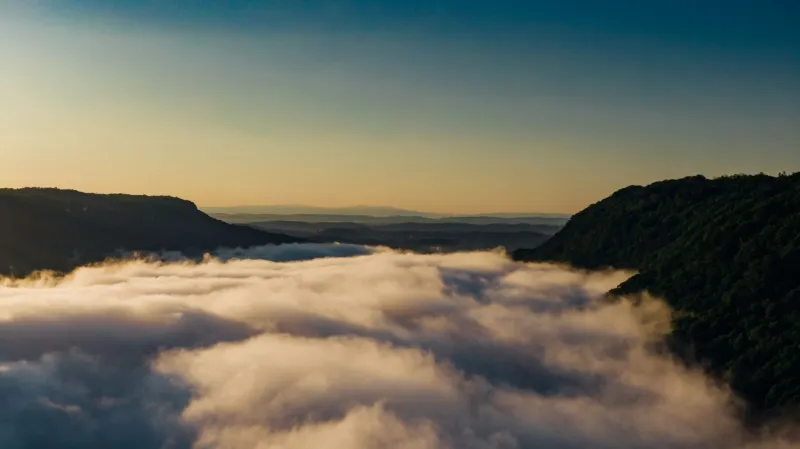
Somewhere in Haywood County, North Carolina, there's a ridge nobody under sixty can explain anymore. Ask around and you'll get a shrug, maybe a half-memory about a great-uncle who farmed up there. But ask Darlene Messer, a retired schoolteacher who has spent the better part of two decades combing through deed books and old USGS surveys, and she'll tell you exactly whose name got pinned to that ridge, when, and why it matters that anybody still knows.
"These names aren't decorations," Darlene says, spreading a hand-annotated topographic map across her kitchen table. "They're the oldest history we've got. Older than the courthouses. Older than most of the churches."
She's not wrong. Long before county lines existed — long before the first European settler hacked a trail through laurel thicket and called it a road — the mountains of Southern Appalachia already had names. The Cherokee called them by words that carried meaning about what lived there, what happened there, what the land itself seemed to be doing. Then came the Scots-Irish, the English, the Germans, the free Black families who carved out homesteads in the hollows, and each wave of arrivals layered new names over old ones, or twisted the old sounds into something their tongues could manage.
What's left is a patchwork. And it's fraying.
A Name Is Never Just a Name
Take Chunky Gal Mountain, straddling the Clay and Macon County line in North Carolina. The name sounds almost whimsical until you start pulling at the threads. Some historians trace it to a Cherokee woman — accounts vary on who she was, but most agree the name stuck because of her, because she mattered to the people living in that place at that time. The mountain remembers her even if the history books mostly don't.
Or consider Soco Gap, the high pass along the Blue Ridge Parkway in Jackson County. Soco comes from the Cherokee word meaning "one place" or, in some translations, "they are meeting." It was a crossroads long before asphalt ever touched it. The gap still functions as a meeting place — tourists pull over for the view, locals use it as a landmark for giving directions — but almost nobody passing through knows they're standing in a spot the Cherokee considered significant enough to name for the act of gathering.
This is the quiet crisis that people like Darlene are trying to address. Not with alarm, exactly. More with urgency.
"When a name disappears, you don't always notice right away," she explains. "It's gradual. First the old-timers go. Then their kids move off. Then somebody from somewhere else buys the land and puts a different name on it for a subdivision or a vacation rental. And then it's just... gone."
The People Who Remember
In Swain County, genealogist Marcus Teague has been cross-referencing family oral histories with nineteenth-century land grants, trying to reconstruct the naming logic behind a cluster of hollows that don't appear on any modern map. He found one — called Suttles Branch on an 1887 survey — that had been informally renamed twice in the twentieth century and now appears on GPS systems under a name that bears no relationship to the family who settled it or the creek that shaped it.
"GPS is killing us," he says, not entirely joking. "When everybody navigates by coordinates and generic road names, the old names stop getting spoken out loud. And once they stop being spoken, they stop being remembered."
Marcus grew up hearing his grandmother refer to landmarks by names he later couldn't find on any official document. It took him years to understand that the official documents were simply incomplete — that entire geographies of meaning had been recorded only in the mouths of people who eventually died.
His current project involves sitting down with residents over seventy and recording not just the names they know, but the stories attached to them. Who lived there. What they grew. Where they buried their dead. Why a particular bend in the creek got called what it got called.
"The name is the key," he says. "But the story is the room it unlocks."
What Gets Lost When the Names Go
The stakes here aren't purely sentimental, though sentiment is a legitimate reason to care about anything. Place names carry practical information. A ridge named for flooding tells you something about where not to build. A hollow named for a plant — and there are dozens across Southern Appalachia named for ramps, for spicewood, for galax — tells you something about what grew there and what the ecosystem once supported. Indigenous place names, in particular, often encoded ecological knowledge that took generations to accumulate.
Ethnobotanist and Western Carolina University researcher Patrice Holloway has spent years examining the overlap between Cherokee place names and traditional plant-use territories. Her findings suggest that the names weren't arbitrary — they were often landmarks in a living map of where to find food, medicine, and shelter across the seasons.
"When you lose the name, you lose the map," she says. "And when you lose the map, you lose the knowledge of how to move through this landscape in a way that's actually sustainable."
That's a heavier loss than most people reckon with when they're renaming a ridge for a new development or letting a hollow's old name drift out of use.
Doing the Work Before It's Too Late
The good news — and there is some — is that the documenting is happening. The Southern Appalachian Highlands Conservancy has supported oral history efforts in several counties. Local genealogical societies in western North Carolina, east Tennessee, and southwest Virginia are increasingly treating place names as primary historical sources rather than footnotes. A few community colleges have launched informal archiving projects, training local volunteers to conduct interviews and cross-reference records.
Darlene Messer has compiled a working index of over four hundred place names in her county alone, each one annotated with whatever origin information she could locate. She's hoping to eventually partner with the county library to make it publicly searchable.
"I'm not trying to freeze anything," she's careful to say. "Places change. Names change. That's natural. I just want there to be a record of what was, so people can make informed choices about what comes next."
There's something fitting about the mountains themselves being the archive. They've been here longer than any of the names we've given them. They'll outlast the names we're using now. But for the people who live among them — whose families were shaped by them, whose identities are tangled up in them — the names are the thread connecting past to present.
Lose the thread and you don't lose the mountain. You just lose the part of yourself that knew how to belong to it.
And that, as anyone raised in a Southern Appalachian hollow will tell you, is no small thing to lose.