Listening for the Ghost of Summer: What Disappearing Whippoorwills Are Telling Us About Our Mountains
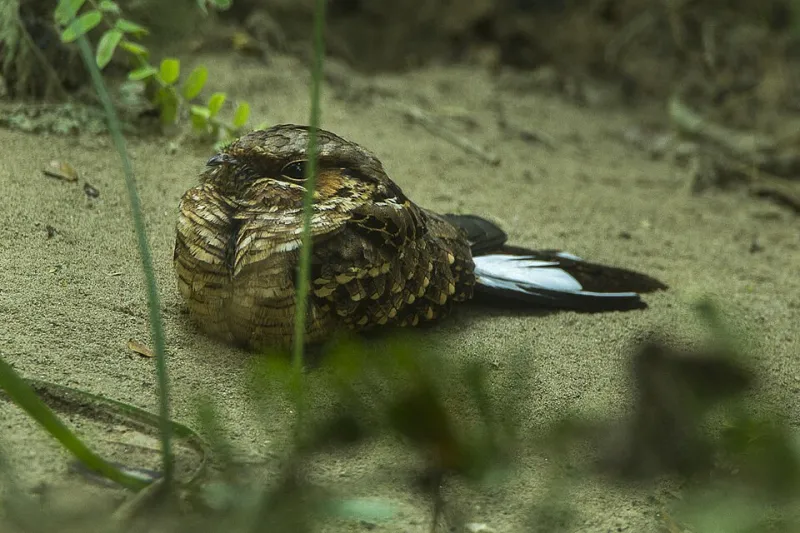
Photo: Francesco Veronesi, CC BY-SA 2.0, via Wikimedia Commons
There's a particular kind of quiet that settles over a Tennessee holler after sundown in late April. The tree frogs warm up. The creek keeps its steady conversation. And if you're lucky — if the habitat is still right and the season has cooperated — somewhere out past the tree line, a bird you almost never see will start calling its own name into the dark.
Whip-poor-will. Whip-poor-will. Whip-poor-will.
For folks who grew up in the mountains of Kentucky, West Virginia, and Tennessee, that call is practically encoded in childhood memory. It meant fireflies were coming. It meant school was almost out. It meant summer had finally, truly arrived in the hills. But lately, more and more people are sitting on those same front porches and hearing nothing but crickets.
A Bird That Belongs to the Night
The Eastern Whip-poor-will (Antrostomus vociferus) is what ornithologists call a nightjar — a family of nocturnal birds built for the dark. Mottled brown and gray, they're nearly impossible to spot during the day, blending into leaf litter and bark so perfectly that you could walk within a foot of one and never know it. Their large eyes gather moonlight. Their wide, bristle-fringed mouths scoop up moths and flying beetles mid-flight.
They winter in Central America and the Gulf Coast, then make their way north each spring, timing their arrival — historically, at least — with the emergence of the moths they depend on. In Appalachia, that arrival has traditionally landed somewhere between late April and mid-May, right when the hardwood canopy is leafing out and the forest floor is buzzing with insect life.
Or it used to.
What the Old-Timers Remember
Ruth Ann Combs, 78, grew up on a farm outside Harlan, Kentucky, and she'll tell you without hesitation that whippoorwills used to be impossible to ignore.
"They'd start up right after dark and go half the night," she says, sitting on the porch of the house where she was born. "My daddy used to say if you heard the first whippoorwill of the year, you should make a wish. We'd all run outside when we heard it coming."
She heard one last spring, she says. Just one, a few nights in a row, and then nothing. The spring before that, nothing at all.
Her neighbor, Dale Sizemore, 64, has been keeping informal notes in a pocket calendar for the past fifteen years — when he first hears the whippoorwill each spring, how many nights it calls, roughly how loud and frequent the chorus seems. "My grandfather did the same thing, just in his head," Dale says. "But I figured I ought to write it down since things started feeling different."
His notes show the first call arriving a week earlier than it did a decade ago. The duration of the chorus — the number of consecutive nights he hears consistent calling — has dropped by more than half.
What the Science Is Saying
Dale's informal observations line up uncomfortably well with what researchers are finding.
The North American Breeding Bird Survey, which has tracked bird populations across the continent since 1966, shows Eastern Whip-poor-will populations have declined by roughly 70 percent over the past five decades. That's not a minor dip. That's a collapse.
Dr. Lianne Garrett, a wildlife ecologist who has spent the last eight years studying nightjar populations in the Southern Appalachians, says the causes are layered and interconnected in ways that make simple solutions hard to come by.
"It's not one thing," she explains. "It's habitat fragmentation from development, it's the decline of open forest understory from fire suppression, it's light pollution disrupting their nocturnal behavior, and increasingly, it's the timing mismatch caused by climate shifts."
That last factor is what researchers call phenological mismatch — when a species' biological calendar falls out of sync with the environment it depends on. Whippoorwills time their breeding to coincide with peak moth abundance, which is itself tied to the timing of plant flowering and leaf-out. As winters warm and springs arrive earlier, the moth emergence is shifting. The birds, navigating by cues built over thousands of years of evolution, aren't always keeping pace.
"They arrive and the buffet has already started winding down," Dr. Garrett says. "It's a small window, and when you miss it, you're feeding chicks on a depleted food source."
The Forest Matters Too
Birder and naturalist Marcus Webb, who leads nocturnal wildlife walks for a nature center in Asheville, North Carolina, points to forest structure as a critical and often overlooked piece of the puzzle.
"Whippoorwills aren't deep-forest birds," he says. "They need edges. Open patches. Places where the canopy breaks and moonlight can reach the ground. That's where they hunt, and that's where they nest — right on the ground, in the leaf litter."
Decades of fire suppression in the Southern Appalachians have allowed dense mid-story vegetation to fill in spaces that once burned regularly, creating the open, patchy forest structure these birds evolved alongside. Ironically, some of the most active whippoorwill habitat remaining in the region exists near areas where prescribed burns are being used to restore forest health.
"Where there's been a burn in the last couple years, you start hearing them again," Marcus says. "It's not magic. It's habitat."
Reasons to Keep Listening
None of this is a eulogy — not yet. Conservation organizations, state wildlife agencies, and private landowners across Kentucky, Tennessee, West Virginia, and the Carolinas are increasingly working together on habitat restoration projects that benefit whippoorwills and dozens of other species tied to open forest ecosystems.
And the bird itself is resilient. It has survived ice ages and continental shifts. It's adapted before.
But Ruth Ann Combs speaks for a lot of people when she says the silence on spring nights feels like something important going missing. Not just a bird. A marker. A thread connecting her to her father, and his father before him, and the particular way this corner of the world has always announced itself when the cold finally breaks.
"You don't realize how much you count on a sound until it's not there anymore," she says, looking out past the darkening ridge line. "I still listen every night. I figure that's the least I can do."
So do we. And we'd encourage you to do the same.